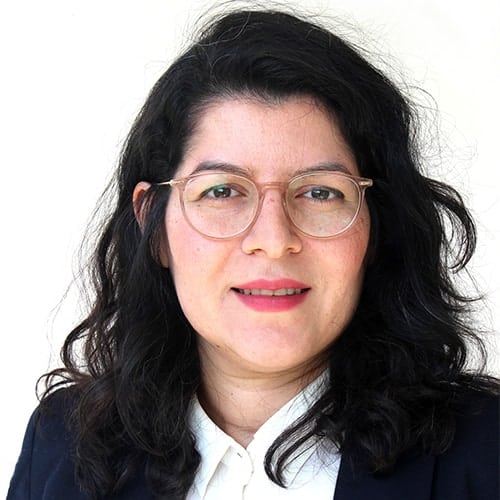
Fariba Karimi leads the research team on Algorithmic Fairness at the Complexity Science Hub and is a professor of Social Data Science at Graz University of Technology.
In 2024, she received an ERC Starting Grant on the topic of Network Fairness. Before joining TU Graz, she served as a tenure-track professor at Vienna University of Technology. She leads the computational social science and algorithmic fairness lab. Her research interests revolve around modeling complex socio-technical networks and the role of AI and algorithms in the diffusion of information and in shaping structural inequalities, and devising computational tools toward algorithmic fairness. In 2023, she received the prestigious Young Scientist Award from the German Physical Society for her contribution to modeling minorities and inequalities in networks.
In recent years, Fariba and her team have received multiple prestigious grants such as the Digital Humanism Grant from the Vienna Science and Technology Fund WWTF), and EU Horizon grant to study multi-criteria fairness in AI systems. In 2023, she received the Young Scientist Award from the German Physical Society for her research on inequality in complex networks.
Fariba received a PhD in physics and computational science from Umeå University in Sweden in 2015 and was a PostDoc at GESIS – Leibniz Institute for Social Sciences in Germany.
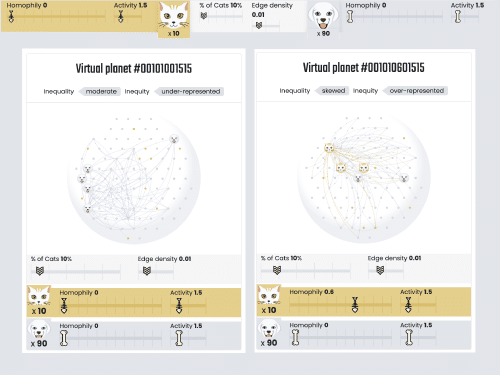
Explore how algorithms work on different types of networks, starting from explaning the essential components and leading to a more advanced explorable dashboard.